GSM
 |
| The GSM logo is used to identify compatible handsets and equipment. The
dots symbolize three clients in the home network and one roaming client. |
GSM (
Global System for Mobile Communications, originally
Groupe Spécial Mobile), is a standard developed by the
European Telecommunications Standards Institute (ETSI) to describe protocols for second-generation (
2G) digital
cellular networks used by
mobile phones, first deployed in Finland in July 1991.
[2] As of 2014
it has become the default global standard for mobile communications -
with over 90% market share, operating in over 219 countries and
territories.
[3]
2G networks developed as a replacement for first generation (
1G) analog cellular networks, and the GSM standard originally described a digital, circuit-switched network optimized for
full duplex voice
telephony. This expanded over time to include data communications, first by circuit-switched transport, then by
packet data transport via
GPRS (General Packet Radio Services) and
EDGE (Enhanced Data rates for GSM Evolution or EGPRS).
Subsequently, the
3GPP developed third-generation (
3G)
UMTS standards followed by fourth-generation (
4G)
LTE Advanced standards, which do not form part of the ETSI GSM standard.
"GSM" is a
trademark owned by the
GSM Association. It may also refer to the (initially) most common voice codec used,
Full Rate.
History
In 1982, work began to develop a European standard for digital cellular voice telephony when the
European Conference of Postal and Telecommunications Administrations (CEPT) created the Groupe Spécial Mobile committee and later provided a permanent technical support group based in
Paris. Five years later, in 1987, 15 representatives from 13 European countries signed a
memorandum of understanding in
Copenhagen
to develop and deploy a common cellular telephone system across Europe,
and EU rules were passed to make GSM a mandatory standard.
[4]
The decision to develop a continental standard eventually resulted in a
unified, open, standard-based network which was larger than that in the
United States.
[5][6][7][8]
In 1987 Europe produced the very first agreed GSM Technical
Specification in February. Ministers from the four big EU countries
cemented their political support for GSM with the Bonn Declaration on
Global Information Networks in May and the GSM
MoU
was tabled for signature in September. The MoU drew-in mobile operators
from across Europe to pledge to invest in new GSM networks to an
ambitious common date. It got GSM up and running fast.
In this short 37-week period the whole of Europe (countries and
industries) had been brought behind GSM in a rare unity and speed guided
by four public officials Armin Silberhorn (Germany), Stephen Temple
(UK), Philippe Dupuis (France), and Renzo Failli (Italy).
[9] In 1989, the Groupe Spécial Mobile committee was transferred from CEPT to the
European Telecommunications Standards Institute (ETSI).
[6][7][7][8]
In parallel,
France and
Germany signed a joint development agreement in 1984 and were joined by
Italy and the
UK in 1986. In 1986 the
European Commission proposed reserving the 900 MHz spectrum band for GSM. The world's first GSM call was made by the former
Finnish prime minister
Harri Holkeri to Kaarina Suonio (mayor in city of
Tampere) on July 1, 1991, on a network built by
Telenokia and Siemens and
operated by
Radiolinja.
[10] The following year in 1992, the first
short messaging service (SMS or "text message") message was sent and
Vodafone UK and Telecom Finland signed the first international
roaming agreement.
Work began in 1991 to expand the GSM standard to the 1800 MHz
frequency band and the first 1800 MHz network became operational in the
UK by 1993. Also that year,
Telecom Australia became the first network operator to deploy a GSM network outside Europe and the first practical hand-held GSM
mobile phone became available.
In 1995, fax, data and SMS messaging services were launched
commercially, the first 1900 MHz GSM network became operational in the
United States and GSM subscribers worldwide exceeded 10 million. Also
this year, the
GSM Association was formed. Pre-paid GSM SIM cards were launched in 1996 and worldwide GSM subscribers passed 100 million in 1998.
[7]
In 2000, the first commercial
GPRS
services were launched and the first GPRS compatible handsets became
available for sale. In 2001 the first UMTS (W-CDMA) network was
launched, a 3G technology that is not part of GSM. Worldwide GSM
subscribers exceeded 500 million. In 2002 the first
Multimedia Messaging Service (MMS) were introduced and the first GSM network in the 800 MHz frequency band became operational.
EDGE services first became operational in a network in 2003 and the number of worldwide GSM subscribers exceeded 1 billion in 2004.
[7]
By 2005, GSM networks accounted for more than 75% of the worldwide
cellular network market, serving 1.5 billion subscribers. In 2005 the
first
HSDPA capable network also became operational. The first
HSUPA
network was launched in 2007. High-Speed Packet Access (HSPA) and its
uplink and downlink versions are 3G technologies, not part of GSM.
Worldwide GSM subscribers exceeded three billion in 2008.
[7]
The
GSM Association
estimated in 2010 that technologies defined in the GSM standard serve
80% of the global mobile market, encompassing more than 5 billion people
across more than 212 countries and territories, making GSM the most
ubiquitous of the many standards for cellular networks.
[11]
It is important to note that GSM is a second-generation (2G) standard
employing Time-Division Multiple-Access (TDMA) spectrum-sharing, issued
by the European Telecommunications Standards Institute (ETSI). The GSM
standard does not include the 3G
UMTS CDMA-based technology nor the 4G LTE
OFDMA-based technology standards issued by the 3GPP.
[12]
Macau planned to phase out its 2G GSM networks as of June 4, 2015, making it the first region to decommission a GSM network.
[13] Singapore will also be phasing out 2G services by April 2017.
Technical details
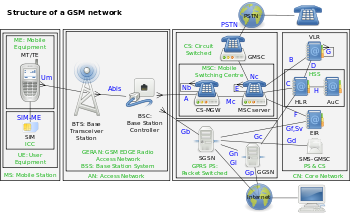 |
| The structure of a GSM network |
Main article:
GSM services
Network structure
The network is structured into a number of discrete sections:
Base station subsystem
GSM is a
cellular network, which means that
cell phones connect to it by searching for cells in the immediate vicinity. There are five different cell sizes in a GSM network—
macro,
micro,
pico,
femto, and
umbrella cells.
The coverage area of each cell varies according to the implementation
environment. Macro cells can be regarded as cells where the
base station antenna
is installed on a mast or a building above average rooftop level. Micro
cells are cells whose antenna height is under average rooftop level;
they are typically used in urban areas. Picocells are small cells whose
coverage diameter is a few dozen metres; they are mainly used indoors.
Femtocells are cells designed for use in residential or small business
environments and connect to the service provider’s network via a
broadband internet connection. Umbrella cells are used to cover shadowed
regions of smaller cells and fill in gaps in coverage between those
cells.
Cell horizontal radius varies depending on antenna height, antenna
gain, and propagation conditions from a couple of hundred meters to
several tens of kilometres. The longest distance the GSM specification
supports in practical use is 35 kilometres (22 mi). There are also
several implementations of the concept of an extended cell,
[14] where the cell radius could be double or even more, depending on the antenna system, the type of terrain, and the
timing advance.
Indoor coverage is also supported by GSM and may be achieved by using an indoor picocell base station, or an
indoor repeater
with distributed indoor antennas fed through power splitters, to
deliver the radio signals from an antenna outdoors to the separate
indoor distributed antenna system. These are typically deployed when
significant call capacity is needed indoors, like in shopping centers or
airports. However, this is not a prerequisite, since indoor coverage is
also provided by in-building penetration of the radio signals from any
nearby cell.
GSM carrier frequencies
GSM networks operate in a number of different carrier frequency ranges (separated into
GSM frequency ranges for 2G and
UMTS frequency bands for 3G), with most
2G
GSM networks operating in the 900 MHz or 1800 MHz bands. Where these
bands were already allocated, the 850 MHz and 1900 MHz bands were used
instead (for example in Canada and the United States). In rare cases the
400 and 450 MHz frequency bands are assigned in some countries because
they were previously used for first-generation systems.
Most
3G networks in Europe operate in the 2100 MHz frequency band. For more information on worldwide GSM frequency usage, see
GSM frequency bands.
Regardless of the frequency selected by an operator, it is divided into
timeslots for individual phones. This allows eight full-rate or sixteen half-rate speech channels per
radio frequency. These eight radio timeslots (or
burst periods) are grouped into a
TDMA frame. Half-rate channels use alternate frames in the same timeslot. The channel data rate for all
8 channels is
270.833 kbit/s, and the frame duration is
4.615 ms.
The transmission power in the handset is limited to a maximum of 2 watts in
GSM 850/900 and
1 watt in
GSM 1800/1900.
Voice codecs
GSM has used a variety of voice
codecs
to squeeze 3.1 kHz audio into between 6.5 and 13 kbit/s. Originally,
two codecs, named after the types of data channel they were allocated,
were used, called
Half Rate (6.5 kbit/s) and
Full Rate (13 kbit/s). These used a system based on
linear predictive coding (LPC). In addition to being efficient with
bitrates,
these codecs also made it easier to identify more important parts of
the audio, allowing the air interface layer to prioritize and better
protect these parts of the signal.
As GSM was further enhanced in 1997
[15] with the
Enhanced Full Rate (EFR) codec, a 12.2 kbit/s codec that uses a full-rate channel. Finally, with the development of
UMTS, EFR was refactored into a variable-rate codec called
AMR-Narrowband,
which is high quality and robust against interference when used on
full-rate channels, or less robust but still relatively high quality
when used in good radio conditions on half-rate channel.
Subscriber Identity Module (SIM)
One of the key features of GSM is the
Subscriber Identity Module, commonly known as a
SIM card. The SIM is a detachable
smart card
containing the user's subscription information and phone book. This
allows the user to retain his or her information after switching
handsets. Alternatively, the user can also change operators while
retaining the handset simply by changing the SIM. Some operators will
block this by allowing the phone to use only a single SIM, or only a SIM
issued by them; this practice is known as
SIM locking.
Phone locking
Sometimes
mobile network operators restrict handsets that they sell for use with their own network. This is called
locking
and is implemented by a software feature of the phone. A subscriber may
usually contact the provider to remove the lock for a fee, utilize
private services to remove the lock, or use software and websites to
unlock the handset themselves.
In some countries (e.g.,
Bangladesh,
Belgium,
Brazil,
Chile,
Germany,
Hong Kong,
India,
Iran,
Lebanon,
Malaysia,
Nepal,
Pakistan,
Poland,
Singapore,
South Africa,
Thailand) all phones are sold unlocked.
[16]
GSM Security
GSM was intended to be a secure wireless system. It has considered the user authentication using a
pre-shared key and
challenge-response,
and over-the-air encryption. However, GSM is vulnerable to different
class of attacks, each of them aiming a different part of the network.
[17]
The development of
UMTS introduces an optional
Universal Subscriber Identity Module
(USIM), that uses a longer authentication key to give greater security,
as well as mutually authenticating the network and the user, whereas
GSM only authenticates the user to the network (and not vice versa). The
security model therefore offers confidentiality and authentication, but
limited authorization capabilities, and no
non-repudiation.
GSM uses several cryptographic algorithms for security. The
A5/1,
A5/2, and
A5/3 stream ciphers
are used for ensuring over-the-air voice privacy. A5/1 was developed
first and is a stronger algorithm used within Europe and the United
States; A5/2 is weaker and used in other countries. Serious weaknesses
have been found in both algorithms: it is possible to break A5/2 in
real-time with a
ciphertext-only attack, and in January 2007,
The Hacker's Choice started the A5/1 cracking project with plans to use
FPGAs that allow A5/1 to be broken with a
rainbow table attack.
[18] The system supports multiple algorithms so operators may replace that cipher with a stronger one.
Since 2000, different efforts have been done in order to crack the A5
encryption algorithms. Both A5/1 and A5/2 algorithms are broken, and
their cryptanalysis has been considered in the literature. As an
example,
Karsten Nohl developed a number of
rainbow tables (static values which reduce the time needed to carry out an attack) and have found new sources for
known plaintext attacks.
[19]
He said that it is possible to build "a full GSM interceptor...from
open-source components" but that they had not done so because of legal
concerns.
[20] Nohl claimed that he was able to intercept voice and text conversations by impersonating another user to listen to
voicemail, make calls, or send text messages using a seven-year-old
Motorola cellphone and decryption software available for free online.
[21]
New attacks have been observed that take advantage of poor security
implementations, architecture, and development for smartphone
applications. Some wiretapping and eavesdropping techniques
hijack the audio input and output providing an opportunity for a third party to listen in to the conversation.
[22]
GSM uses
General Packet Radio Service (GPRS) for data transmissions like browsing the web. The most commonly deployed GPRS ciphers were publicly broken in 2011.
[23]
The researchers revealed flaws in the commonly used GEA/1 and GEA/2
ciphers and published the open-source "gprsdecode" software for
sniffing
GPRS networks. They also noted that some carriers do not encrypt the
data (i.e., using GEA/0) in order to detect the use of traffic or
protocols they do not like (e.g.,
Skype),
leaving customers unprotected. GEA/3 seems to remain relatively hard to
break and is said to be in use on some more modern networks. If used
with
USIM to prevent connections to
fake base stations and
downgrade attacks, users will be protected in the medium term, though migration to 128-bit GEA/4 is still recommended.
source :
Wikipedia


